Dental Implants in Turkey: Cost, Trips and Aftercare
See the price difference honestly, meet us in the UK before you fly, and travel with a written plan.
At a glance
- How long it takes
- Two trips. Roughly 3–5 days for placement, then 3–7 days for the crown after healing — usually 3–6 months apart.
- Best for
- You are missing one or more teeth and want a fixed replacement rather than a denture
- Priced
- per implant, including crown
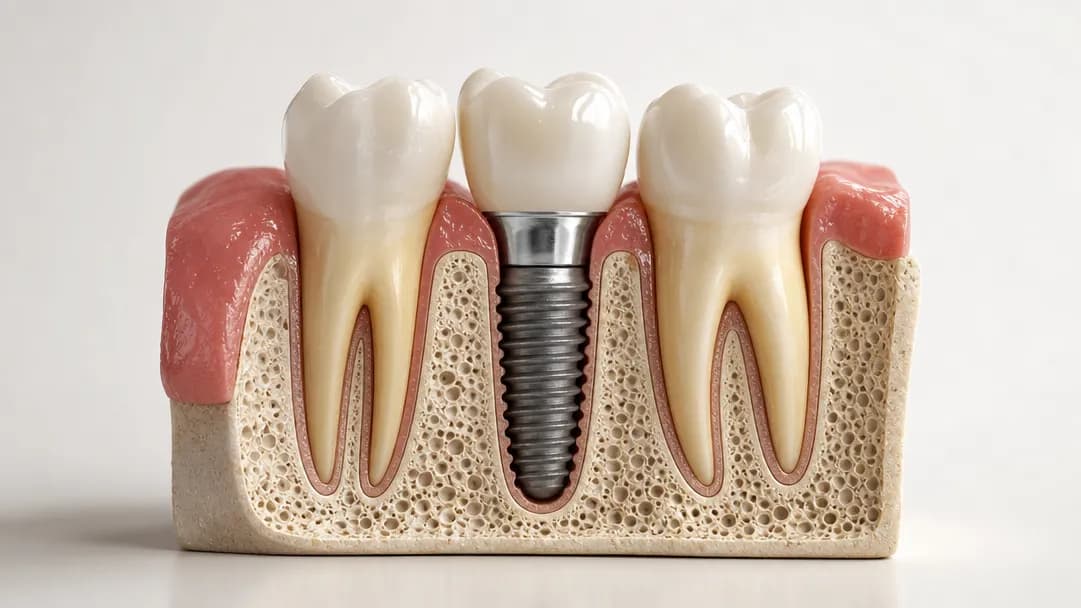
A dental implant replaces the root of a missing tooth with a titanium post that fuses to the jawbone, and carries a crown on top. It is the closest thing dentistry has to a replacement tooth that behaves like your own. In the UK it is almost always a private treatment — the NHS funds implants only in narrow clinical circumstances — which is why so many UK patients start pricing it up abroad.
What dental implants treatment involves
Treatment runs in two stages. On the first trip the failing tooth is removed if it is still there, the implant is placed in the jaw, and a temporary tooth is fitted so you do not fly home with a gap. The implant then needs time to integrate with the bone — usually around three to six months, depending on where in the mouth it sits and the quality of the bone. On the second trip the permanent crown is made and fitted. Some cases allow an immediate-load approach where a temporary crown goes on the same day, but that is a clinical decision, not a package option: it depends on how firm the implant is at placement. If a clinic promises immediate teeth before anyone has seen your bone, treat that as a warning sign rather than a selling point.
What you get
- Replaces a missing tooth without cutting down the healthy teeth either side of the gap
- Preserves the jawbone at the site, which shrinks when a tooth root is missing
- Fixed in place — nothing to remove, and it is cleaned like a natural tooth
- Priced and planned before you travel, with the total written down
Whether it suits you
- You are missing one or more teeth and want a fixed replacement rather than a denture
- You have been quoted a UK private price you can't justify
- You have enough jawbone, or are willing to have a graft first
- You do not smoke heavily and your gums are healthy or treatable
When it is the wrong treatment
- Your gum disease has not been treated — an implant sits in the same bone that disease is destroying, and it has to be stabilised first
- You smoke heavily and are not willing to stop around the surgery, which is one of the few things clearly linked to implants failing
- You need the gap filled in the next fortnight — with healing time this is a treatment measured in months, not days
- You cannot commit to a second trip, and your case is not one of the minority suitable for a single visit
Cost
What dental implants cost, all in
The whole trip rather than the treatment on its own: 2 sets of return flights, hotel and transfers counted alongside the price, against what UK private treatment costs. It has a page of its own, with the calculator, what moves the number, and the cases where travelling does not pay.
- The UK range, with its source and date
- Flights counted 2 times, hotel and transfers on top
- A calculator that will tell you when it is not worth it
Ranges, not quotes. Your own figure is fixed in writing after the UK examination.
The choices inside an implant quote
Two quotes for "one implant" can describe genuinely different treatments. These are the four decisions that move both the price and the outcome, and all four should be settled in writing before you pay a deposit.
A named, branded implant system
A system with a manufacturer, a catalogue and a documented clinical record — Straumann, Nobel Biocare, MegaGen, Osstem and others sit here.
- Best for
- Everyone, and particularly anyone who expects to be living in the UK in fifteen years' time.
- Trade-off
- It is usually the most expensive single component in the quote, and a premium system adds more again.
An unnamed or "clinic's own" implant
An implant the clinic will not name, or names only as a generic. It is where a surprisingly cheap quote is usually coming from.
- Best for
- Nothing we would put our name to. Ask for the brand and the certificate; a vague answer is the answer.
- Trade-off
- If the abutment loosens or the crown needs remaking years later, a UK dentist has to identify the system before they can order a matching part — and with an unbranded implant, they often cannot.
Immediate loading — a temporary tooth the same day
A temporary crown fitted at the time of surgery, so you are not walking around with a gap.
- Best for
- Cases where the implant is measurably firm at placement, most often a single front tooth in good bone.
- Trade-off
- It is decided in surgery from how the implant sits, not in advance from a photograph. Any clinic promising same-day teeth before it has seen a scan is selling a package, not planning treatment.
A bone graft or sinus lift first
Rebuilding height or width of bone so there is something for the implant to hold on to.
- Best for
- Sites where a tooth has been missing long enough for the bone to shrink, and upper back teeth sitting under the sinus.
- Trade-off
- It adds cost, and it adds months before the implant can even be placed. It is also the single most common thing found on a CBCT scan that was not visible on a photograph.
How long dental implants take, day by day
Typical timings for a straightforward case. Your own dates come out of the written plan after the UK examination — this is what to budget annual leave against.
Before you fly
Stage 1 of 7UK examination, X-rays and a written plan
We look in your mouth in person in the UK, take the imaging, and write the plan and the price down. This is the step that turns a photograph-based estimate into something you can hold someone to — and the step at which some people are told they should not travel at all.
Trip 1 · day 1
Stage 2 of 7Consultation and CBCT in Antalya
A 3D scan at the clinic confirms bone height and width at each site and the position of the nerve and sinus. The plan is either confirmed or changed in front of you before anything is done.
Trip 1 · day 2
Stage 3 of 7Surgery: extraction if needed, then placement
Under local anaesthetic, with sedation available. Any tooth still in the site comes out, the implant goes in, and a temporary tooth is fitted where the case allows it.
Trip 1 · days 3–5
Stage 4 of 7Review, then home
Swelling is checked, the temporary is adjusted, aftercare is gone through, and you fly home. Most people book five nights for this trip.
At home · 3–6 months
Stage 5 of 7The implant fuses to the bone
Osseointegration. No clinic can compress it and no package can shorten it — this is the reason implants are a two-trip treatment. You are chewing on your other teeth and living normally throughout.
Trip 2 · days 1–2
Stage 6 of 7Scan or impression for the permanent crown
The healed implant is uncovered where needed, and the crown is designed and sent to the laboratory. Shade is agreed with you, in daylight, before it is made.
Trip 2 · days 3–7
Stage 7 of 7Crown fitted, bite adjusted, then home
The permanent crown is fitted and the bite checked and adjusted. You leave with the implant's brand, reference and your written guarantee — the paperwork a UK dentist will ask for.
Stage by stage
What dental implants actually involves
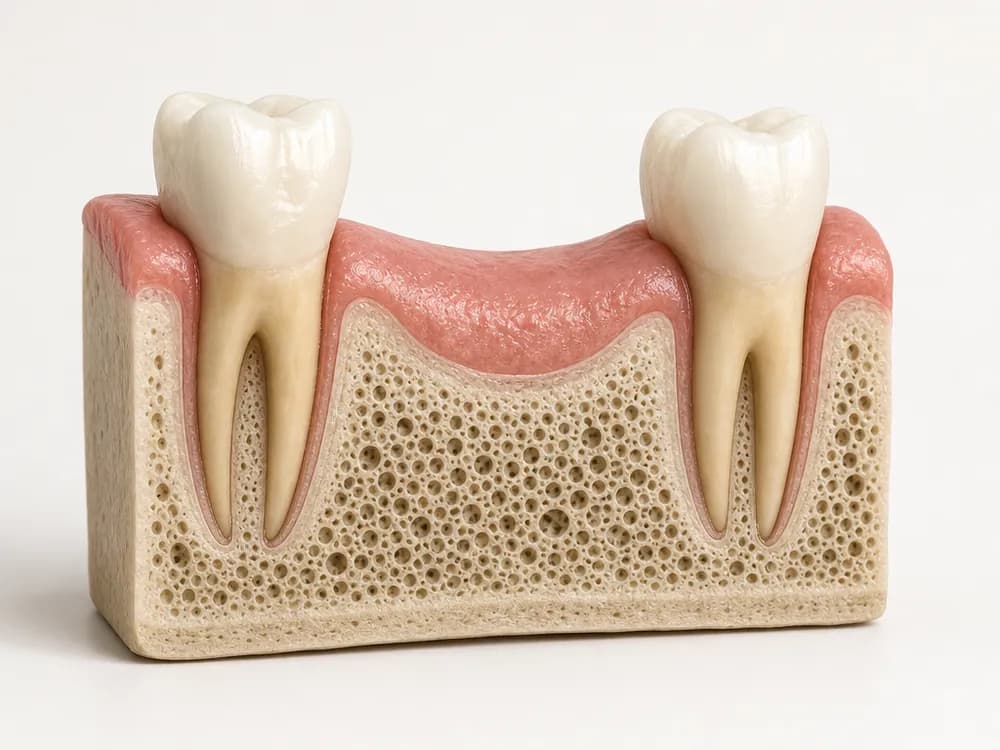
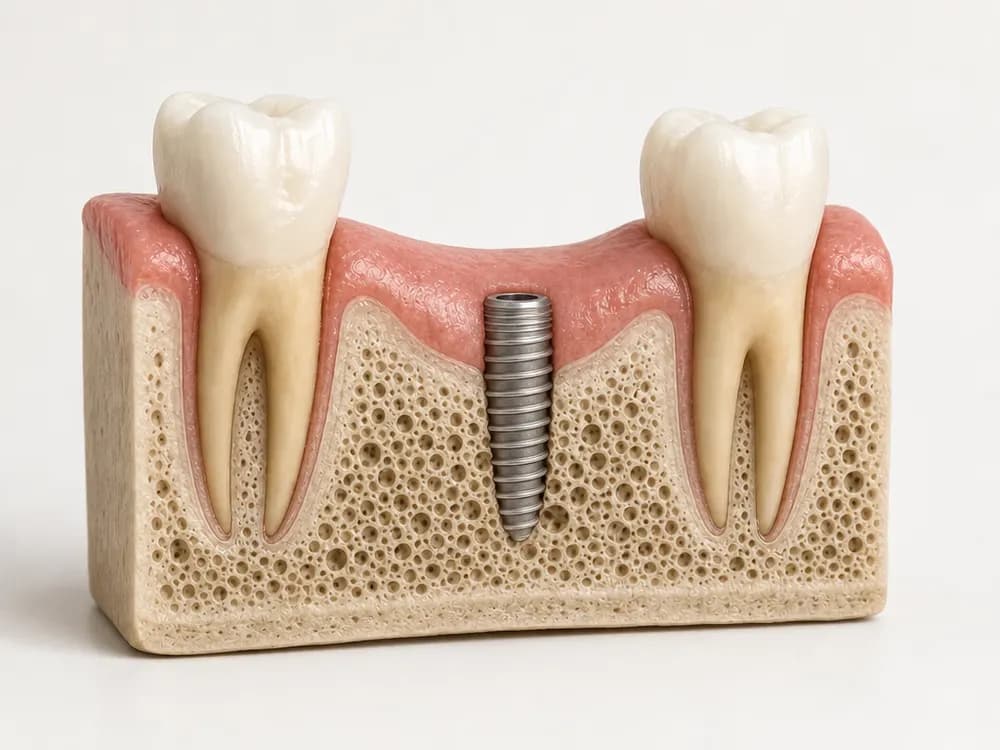
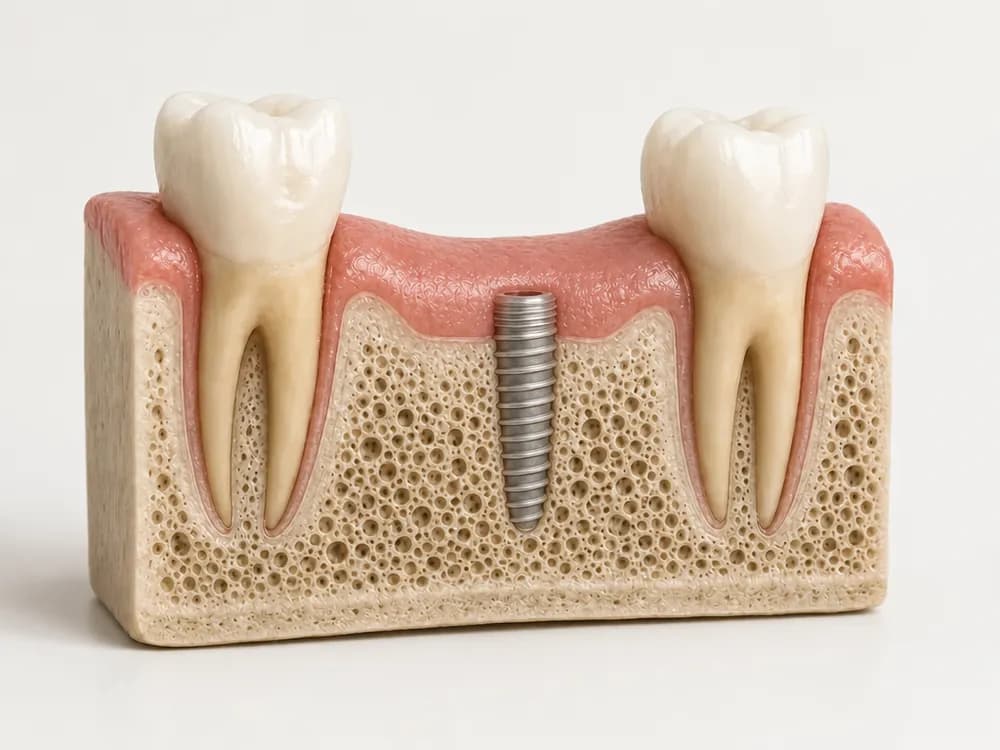
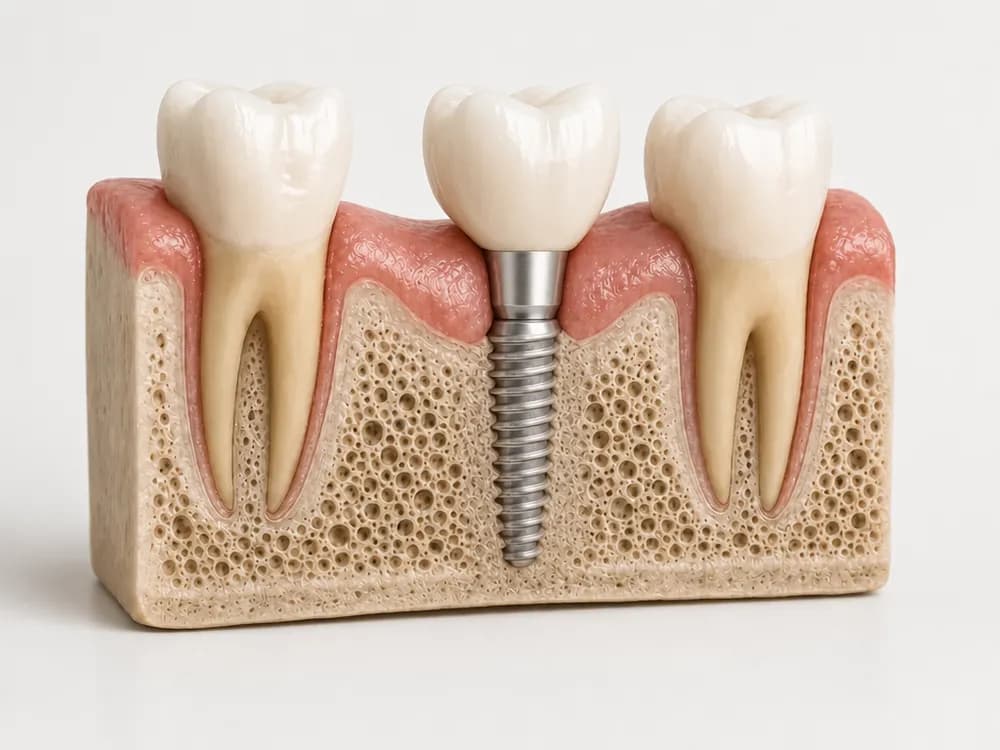
The same schedule as above, shown rather than described. Four stages, on anatomical models — nothing here is a photograph of a patient or of a result.
Trip 1 · day 2
Step 1: The gap, before anything is placed
A missing tooth leaves a space, and the bone under it starts to shrink from the day it goes. The teeth either side are healthy and stay untouched — which is the whole argument for an implant over a bridge.
Trip 1 · day 2
Step 2: The implant goes in
A titanium post is placed into the bone where the root used to be, and the gum is closed over it. This is the surgical appointment, and it is the only one in the whole sequence.
At home · 3–6 months
Step 3: The bone grows onto it
Bone knits directly onto the threads until the implant is held as firmly as a root. This is why implants need two trips: nothing can be loaded onto it until this has happened, and it cannot be hurried.
Trip 2 · days 3–7
Step 4: The tooth goes on
An abutment is fitted to the implant and the permanent crown goes on top, shaped and shaded to match the teeth either side. The bite is checked and adjusted before you fly home.
Medical renders of the stages of the procedure, on anatomical models. Not photographs of a patient, and not a before-and-after — no result shown here belongs to anyone. Your own case is planned at the UK examination.
Real cases
Ballıpınar's own patients, before and after
Photographs, not renders — published by the clinic itself. What we know about each case is written under it, and so is what we don't.
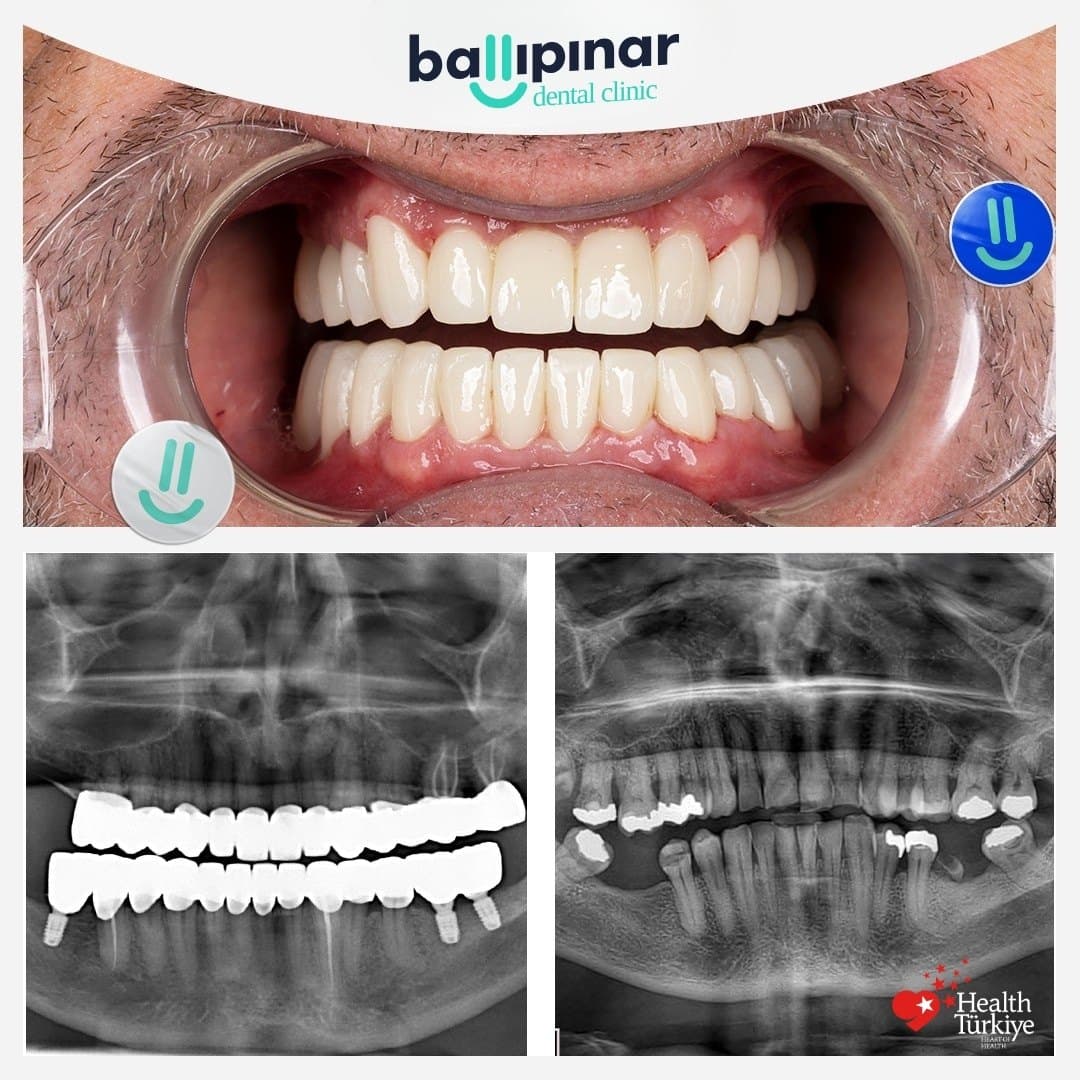
Before: Discoloured, unevenly worn front teeth. 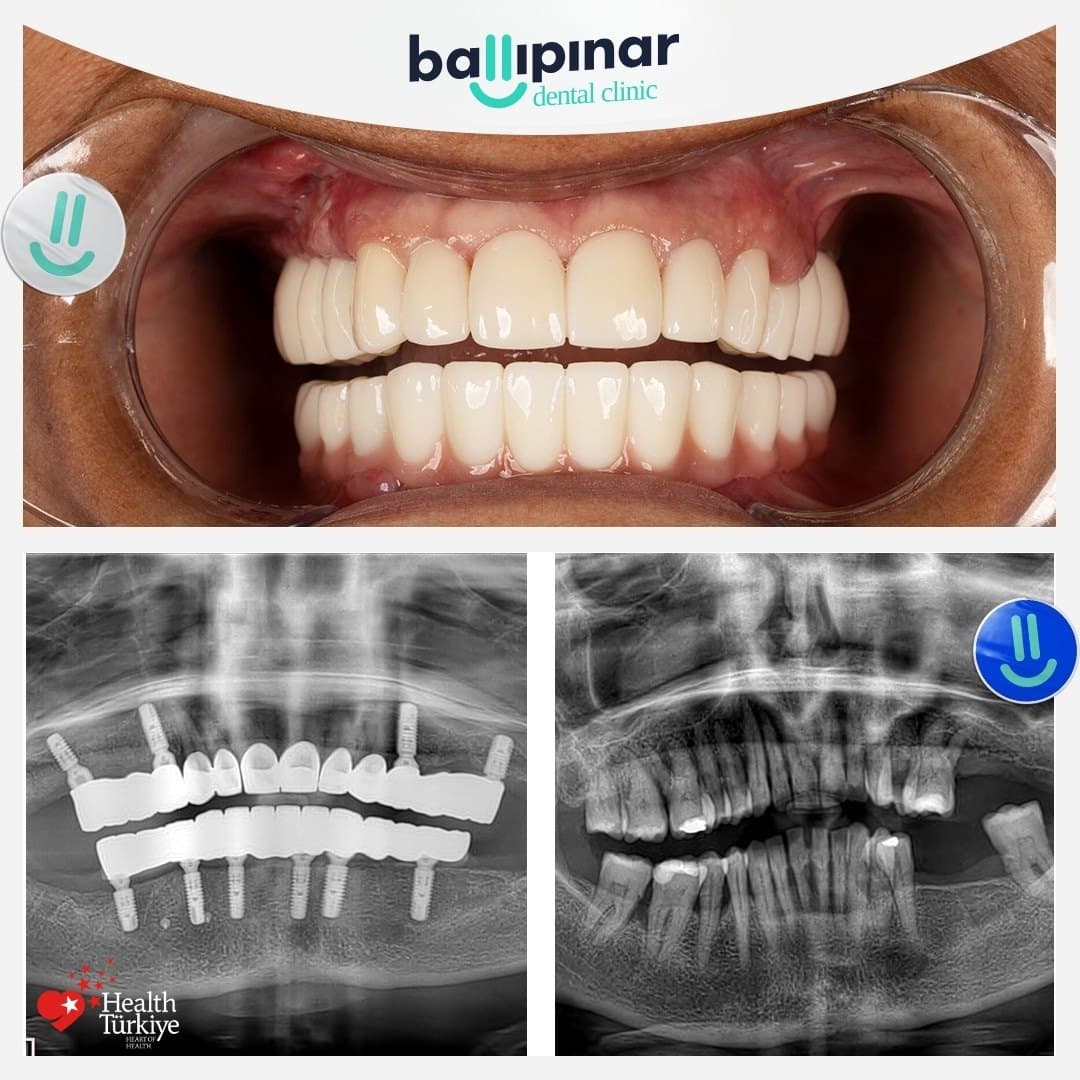
Before: Gapped, discoloured front teeth.
Ballıpınar's own patients, published by Ballıpınar. Mirrored on 18 August 2026 (original eight) and 18 September 2026 (nine more, by treatment) from Ballıpınar Dental Centre's own published case gallery. Nothing on this page is generated, and no other clinic's photographs appear anywhere on this site.
What we cannot tell you about them. The clinic's gallery carries no case notes, so we do not know which materials were used in each case, how long after treatment the second photograph was taken, or whether either photograph was edited. We would rather say that than imply a timescale nobody has confirmed.
2 cases, not a typical result. What is achievable depends on your own teeth, gums and bone, and is assessed at the UK examination — not from a photograph of somebody else. Some people are told a smaller job would suit them better, and some are told to have gum treatment first.
How it works
From your UK examination to Antalya
We see you in person in the UK before anything is booked. It's the step that turns a photograph-based estimate into a plan.
Send us photos and any X-rays you have
OnlineA few photos of your teeth and whatever your UK dentist has already given you. We come back with an idea of what's possible and a ballpark cost — free, and with no obligation to go further.
See us in person in the UK
In the UKWe examine you face to face at a clinic in the UK before anything is booked. It's the step that lets us plan properly rather than guess from a photograph, and it means you meet someone before you commit to flying.
Get a written plan with a fixed price
In the UKTooth by tooth: what's being done, which materials, how many trips, and what the total is. Nothing on it changes once you've agreed it, and anything not included is listed as not included.
Fly to Antalya
In AntalyaYou book the flights; we arrange the airport transfer and hotel. Your coordinator has your schedule and meets you on arrival.
Treatment at the clinic
In AntalyaCarried out by the dental team at Ballıpınar in Antalya, to the plan you signed off. Your coordinator stays with you across appointments.
Recovery, and how long dental implants last
Implant surgery is minor surgery, and it behaves like it. The pattern below is what most people experience; anything sharply outside it is worth a phone call rather than a wait.
- First 48 hours
- Swelling and some bruising, managed with ice and ordinary painkillers. Soft, cool food. No smoking, no rinsing vigorously, no straws and no alcohol — all four disturb the clot the site is healing under.
- Days 3–7
- Swelling peaks around day two or three and then settles. Most people are back at desk work within a couple of days. Warm salt-water rinses start once you are told to, and you chew on the other side.
- Weeks 2–12
- You feel normal long before the implant is ready. The temporary tooth is there for appearance and speech, not for biting into things — treating it as a finished tooth is the most common way people cause themselves a problem in this window.
- Call someone if…
- Pain is increasing rather than decreasing after day three, you have a fever, numbness in the lip or chin has not lifted, or the temporary comes away. None of these are emergencies to sit on quietly, and you should not need a flight to get an answer.
How long it lasts
The honest framing is that an implant has two parts with two different lifespans. The titanium post in the bone is the long-term component — where it integrates and the gum around it stays healthy, it is designed to stay. The crown on top is a wearing part, like any other crown: it can chip, its bonding can fail, and it may be remade at some point in the life of the implant. What actually decides how long the whole thing lasts is not the country it was placed in — it is gum health, whether you grind, whether you smoke, and whether you see a hygienist. Anyone quoting you a guaranteed number of years is quoting you a marketing figure, and you should ask instead what the written guarantee covers and for how long.
What can go wrong with dental implants, and what reduces it
Every item here can happen in a UK practice too. What travelling changes is how easily it gets sorted out — which is the reason this site puts a UK examination in front of a flight.
The implant does not integrate with the bone
It is uncommon, and it is not evenly distributed: smoking, uncontrolled diabetes, untreated gum disease and poor bone quality carry most of it. An honest pre-treatment assessment — and being told no — is the mitigation.
Something is found only after you have landed
A UK examination and imaging before you book anything, and a written plan that says what happens to the price if the plan changes.
Nobody at home can service it
Leave with the implant brand, the reference numbers, your radiographs and the guarantee in writing. A UK dentist can work with a named system; they cannot order a part for an implant nobody will identify.
Being sold more treatment than you need
Ask for the plan tooth by tooth before any deposit, and ask what happens to each tooth that turns out to need a root canal. A plan that starts with a unit count rather than an examination is a package.
Nerve or sinus involvement
3D CBCT planning rather than a flat panoramic X-ray alone. This is standard, and a clinic that plans lower back implants without one is cutting a corner you cannot see.
“Will a UK dentist touch it when I get home?”
It is the most asked question about dental treatment abroad, and the answer is more practical than most of the arguing suggests. UK dentists are not refusing work on principle. They are refusing to guarantee treatment they did not carry out and cannot identify — and on that, they are right. A dentist asked to adjust a crown needs to know what it is made of; asked to service an implant, they need the system and the part numbers.
So the thing that decides how this goes for you is paperwork, and it is settled before you fly rather than after. You leave with the materials named, the components identified, your radiographs and a written guarantee that says what is covered and for how long. And because we examine you in the UK before anything is booked, there is a named person here to call — not only a WhatsApp number in another time zone.
For implants this matters more than for anything else on this site, because the part that stays in you is a manufactured component with a part number. You go home with the system named in writing, the reference numbers, your radiographs and the guarantee — which is what a UK dentist needs before they will take responsibility for adjusting or remaking anything.
This answer applies to dental implants treated at our Antalya clinic.
When dental implants are not the answer
We would rather lose the enquiry than sell you the wrong treatment. Any of these can be the better call, and the UK examination is where that gets decided.
A conventional bridge
When the teeth either side of the gap are already crowned or heavily filled, so nothing healthy is being cut down to carry it.
A partial or full denture
When surgery is ruled out on health grounds, when there is not enough bone and grafting is not wanted, or when the budget simply is not there. It is a legitimate treatment, not a failure.
All-on-4 or All-on-6
When you are replacing a whole arch. Individually implanting every missing tooth in an arch is usually the more expensive and more invasive way to the same result.
NHS treatment
In the narrow clinical circumstances the NHS funds implants for — after mouth cancer treatment or trauma, or where a denture cannot be tolerated for a medical reason. Worth asking about before assuming private is the only route.
| Treatment | Trips | Time in Antalya | Cost |
|---|---|---|---|
| ImplantsThis pageSurgical | Two | Two trips. Roughly 3–5 days for placement, then 3–7 days for the crown after healing — usually 3–6 months apart. | Costs in full |
| VeneersCosmetic | One | One trip, usually 5–7 days from preparation to fitting. | See costs |
| All-on-4Surgical | Two | Two trips. Around 7–10 days for surgery and the temporary bridge, then 5–7 days for the final bridge 3–6 months later. | See costs |
| All-on-6Surgical | Two | Two trips. Around 7–10 days for surgery, then 5–7 days for the final bridge 3–6 months later. | See costs |
| Hollywood SmileCosmetic | One | One trip, usually 6–8 days. | See costs |
| CrownsRestorative | One | One trip, usually 5–7 days. | See costs |
| WhiteningPreventive | One | One trip, 1–3 days — often combined with other treatment. | See costs |
Where people travel from
Each of these pages works out what dental implants would cost from that town — the treatment, plus the return flight from the airport we route the town through, counted once for every trip the treatment needs. The UK prices they compare against are national ranges rather than any one town's.
Common questions
Will a UK dentist work on implants placed in Turkey?
Most will, and the ones who hesitate are usually hesitating for a specific reason rather than out of principle: they cannot tell what was used. A UK dentist asked to adjust or replace a crown needs to know the implant system so they can order the matching parts. If you go home with the brand, the reference numbers and your radiographs, you are asking them to do ordinary work on identifiable components. If you go home with none of that and an implant nobody will name, you are asking them to guarantee somebody else's anonymous hardware — and that is a fair thing to refuse. Ask any clinic, before you book, exactly what paperwork you leave with.
How long do I have to stay in Turkey for dental implants?
Roughly 3–5 days on the surgical trip and 3–7 days on the crown trip, with three to six months of healing in between at home. We book five nights per trip as standard, which leaves room for a review appointment before you fly rather than a dash to the airport.
Why are dental implants cheaper in Turkey?
Mostly costs that have nothing to do with your mouth: staff wages, clinic rent, lab fees and the exchange rate are all lower in Türkiye than in the UK. The implant components themselves are bought on a global market — a Straumann or Nobel Biocare implant costs a Turkish clinic roughly what it costs a UK one. Ask any clinic to name the implant brand and show you the certificate; if the answer is vague, the saving is coming from somewhere you would not choose.
Do I need to fly out twice?
For most implant cases, yes. The implant needs months to fuse with the bone before it can carry a permanent crown, and no clinic can compress that biology. Single-trip implant treatment exists but suits a minority of cases. We tell you which you are after the UK consultation, not after you land.
How much is a full mouth of dental implants in Turkey?
It depends entirely on what "full mouth" turns out to mean for you, which is why the figures you find online vary so wildly. Replacing every missing tooth with its own implant and crown is one treatment; carrying a whole arch on four or six implants with a fixed bridge is a completely different one, usually for considerably less. Most people asking this question want the second. Our All-on-4 and All-on-6 pages set out what each involves, and your own figure comes from the written plan after the UK examination.
Can I get same-day implants in Turkey?
Sometimes — an immediate-load approach fits a temporary crown at the time of surgery. Whether you are suitable is measured at placement, from how firm the implant is in the bone, and it is more often possible for a single front tooth in good bone than for a back tooth taking heavy chewing load. What you should not accept is a same-day promise made before anyone has seen a scan. The permanent crown still comes later either way.
How long do implants placed in Turkey last?
The same as implants placed anywhere else, because the variables are yours rather than geographical: gum health, grinding, smoking and hygienist visits. The post in the bone is the long-term part; the crown on top is a wearing part that may be remade during its life. Treat any clinic quoting you a guaranteed lifespan as guessing, and read the written guarantee instead.
Is it safe to have dental implants in Turkey?
The country is not the variable — the clinic is, and so is the plan. What makes it safe is being examined properly before anything is agreed, being told if you are not a candidate, having the implant system named, having the treatment planned from a 3D scan rather than a photograph, and knowing who answers the phone when you are back in Sheffield at eleven at night. Those are all questions you can ask before you pay anything, and the answers separate clinics far more reliably than the country does.
What happens if something goes wrong after I get home?
You get a written guarantee that states what is covered and for how long, and a UK point of contact rather than only a WhatsApp number abroad. Ask every clinic you shortlist the same question and compare the answers in writing — this is where cheap quotes usually stop being cheap.
Can I get implants on the NHS?
Rarely. NHS dentistry funds implants only where there is a clear clinical need — for example after mouth cancer treatment or trauma, or where a denture cannot be tolerated for a medical reason. Replacing a tooth for appearance or convenience is treated as private work, which is why UK implant prices land where they do.
No obligation
Find out what your treatment would actually cost
Send us a few details and we'll come back within a working day with what's involved and what it costs. We examine you in the UK before anything is booked.
We'll tell you if you're better off treated at home.