All-on-4 Implants in Turkey: Cost, Trips and Recovery
A full arch of fixed teeth on four implants — what it involves, and what it should cost.
At a glance
- How long it takes
- Two trips. Around 7–10 days for surgery and the temporary bridge, then 5–7 days for the final bridge 3–6 months later.
- Best for
- You have lost most or all of the teeth in an arch, or they are beyond saving
- Priced
- per arch, including final bridge
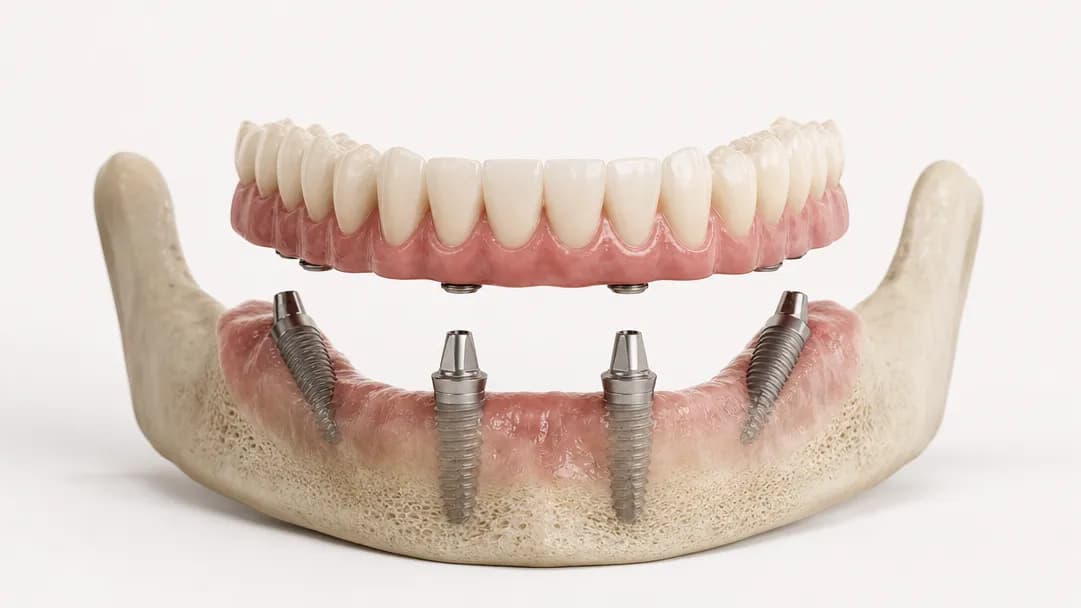
All-on-4 replaces a whole arch of teeth with a fixed bridge carried on four implants, two of which are angled to make use of the bone that is still there. It was designed precisely for people who have been told they do not have enough bone for a conventional implant plan, and it is the usual alternative to a full denture.
What all-on-4 implants treatment involves
The surgery is done in one visit per arch. Any remaining teeth in that arch are removed, the four implants are placed, and a fixed temporary bridge is attached — you leave the clinic with teeth. The permanent bridge is made once the gums have settled and the implants have integrated, which is why a second trip follows a few months later. Recovery is real: expect swelling and a soft diet for a week or two, and plan your flights around that rather than around a holiday itinerary. All-on-4 is a big, largely irreversible decision, so the UK consultation matters more here than anywhere else in this list — a scan and a face-to-face examination should come before any figure is agreed.
What you get
- Fixed teeth on the day of surgery rather than a removable denture
- Often possible without bone grafting, because the back implants are angled
- One surgical visit per arch
- A total price agreed in writing before travel, including the final bridge
Whether it suits you
- You have lost most or all of the teeth in an arch, or they are beyond saving
- You are struggling with a denture that moves
- You have been turned down for conventional implants because of bone loss
- You can commit to two trips and to hygienist maintenance afterwards
When it is the wrong treatment
- Most of your teeth are sound — All-on-4 means removing the ones that are left in that arch, and that is not a decision to reach for early
- You cannot get back for the second trip, or cannot commit to hygienist maintenance afterwards
- You want the treatment finished and forgotten; a fixed full arch needs cleaning under it, every day, for as long as you have it
- Your gum disease or general health has not been stabilised — this is major implant surgery, not a cosmetic appointment
Cost
What all-on-4 implants cost, all in
The whole trip rather than the treatment on its own: 2 sets of return flights, hotel and transfers counted alongside the price, against what UK private treatment costs. It has a page of its own, with the calculator, what moves the number, and the cases where travelling does not pay.
- The UK range, with its source and date
- Flights counted 2 times, hotel and transfers on top
- A calculator that will tell you when it is not worth it
Ranges, not quotes. Your own figure is fixed in writing after the UK examination.
The choices inside a full-arch quote
Full-arch quotes differ far more than they look, because "a full set of teeth" describes an outcome rather than a treatment. These are the decisions behind the number.
Four implants (All-on-4)
Two straight implants at the front, two angled at the back to reach the bone that is still there.
- Best for
- Arches with reduced bone at the back, where the alternative would be grafting or a sinus lift.
- Trade-off
- Fewer points of support. In a lower jaw with heavy chewing forces, some clinicians would rather spread the load across six.
Six implants (All-on-6)
The same fixed bridge, carried on six implants instead of four.
- Best for
- Where there is enough bone in six sites and the bite puts heavy force through the restoration.
- Trade-off
- More surgery and a higher price. It is not automatically better — it is better where the bone and the bite call for it.
Acrylic bridge on a metal framework
The common permanent option: acrylic teeth over a titanium bar. Repairable, and a tooth can be replaced without remaking everything.
- Best for
- Most people, and anyone who wants repairs to be straightforward and affordable.
- Trade-off
- The acrylic wears and discolours over years and will eventually need refurbishing.
Monolithic zirconia bridge
The whole arch milled from one block of zirconia.
- Best for
- Heavy bites and anyone who wants the most wear-resistant option available.
- Trade-off
- Considerably more expensive, and a fracture means remaking the bridge rather than repairing a tooth on it.
How long all-on-4 implants take, day by day
Typical timings for a straightforward case. Your own dates come out of the written plan after the UK examination — this is what to budget annual leave against.
Before you fly
Stage 1 of 6UK examination and imaging
For a treatment this large, the face-to-face examination is not a formality. Bone, gum condition, your bite and your general health all get looked at, and the plan and the price are written down before you commit to anything.
Trip 1 · day 1
Stage 2 of 6CBCT scan and final planning
The 3D scan decides implant number, angle and position. If it says six rather than four, you are told before surgery and not after.
Trip 1 · day 2
Stage 3 of 6Surgery and the fixed temporary bridge
Remaining teeth in the arch are removed, the implants are placed, and a fixed temporary bridge is attached — usually the same day or the day after. You do not go home toothless.
Trip 1 · days 3–10
Stage 4 of 6Review, adjustment, then home
Swelling peaks and settles, the bridge is adjusted, and you are shown how to clean underneath it. This trip is longer than a single implant trip for a reason — book 7 to 10 days.
At home · 3–6 months
Stage 5 of 6Healing and integration
The gums settle into their final shape and the implants integrate. You are eating soft to normal food on the temporary bridge throughout, and you should be seen at home if anything feels wrong.
Trip 2 · days 1–7
Stage 6 of 6The permanent bridge
Scans and try-ins for fit, bite and appearance, then the final bridge is fitted. Five to seven days, because a full arch is fitted in stages rather than handed over.
Stage by stage
What all-on-4 implants actually involves
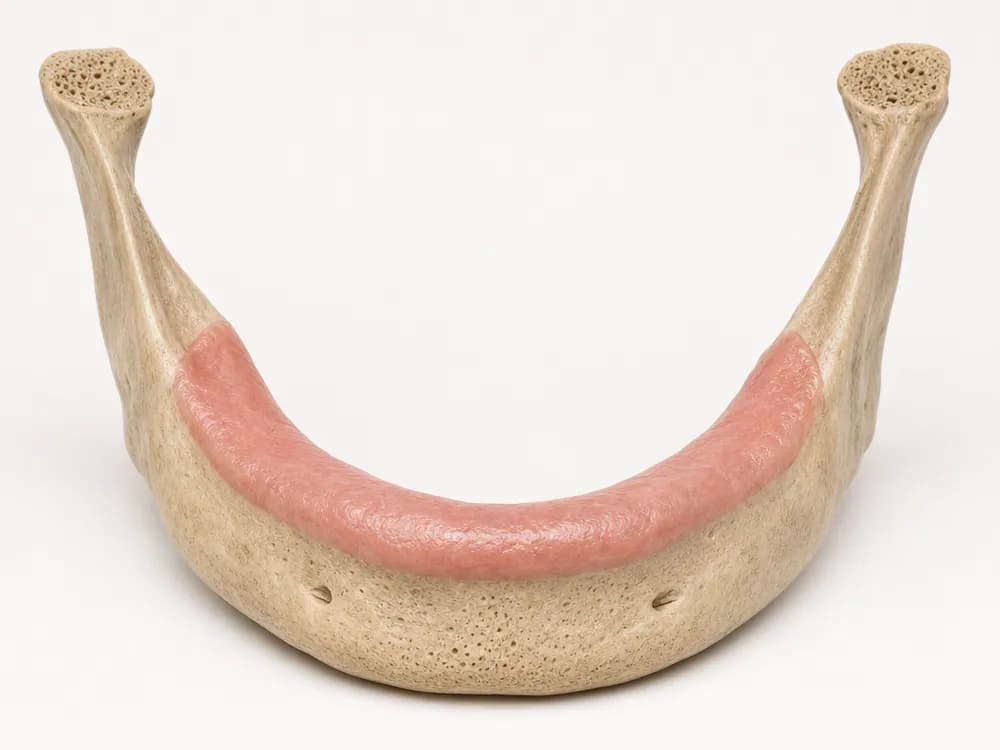
The same schedule as above, shown rather than described. Four stages, on anatomical models — nothing here is a photograph of a patient or of a result.
Trip 1 · day 1
Step 1: The jaw, scanned and planned
A CBCT scan shows where the bone is dense enough to take an implant. That is what decides the positions — and, on the day, whether four is the right number for you.
Trip 1 · day 2
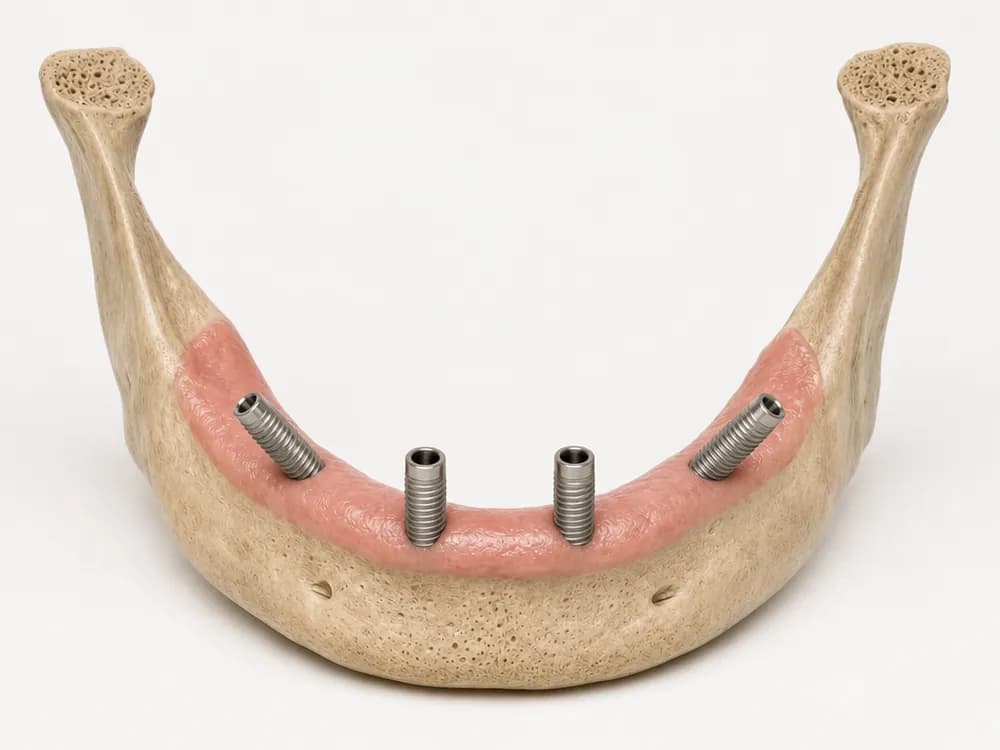
Step 2: Four implants, two of them angled
Two upright at the front, two tilted back at the rear. The tilt is the point: it reaches denser bone further forward and often avoids the graft that would otherwise be needed.
Trip 1 · day 2
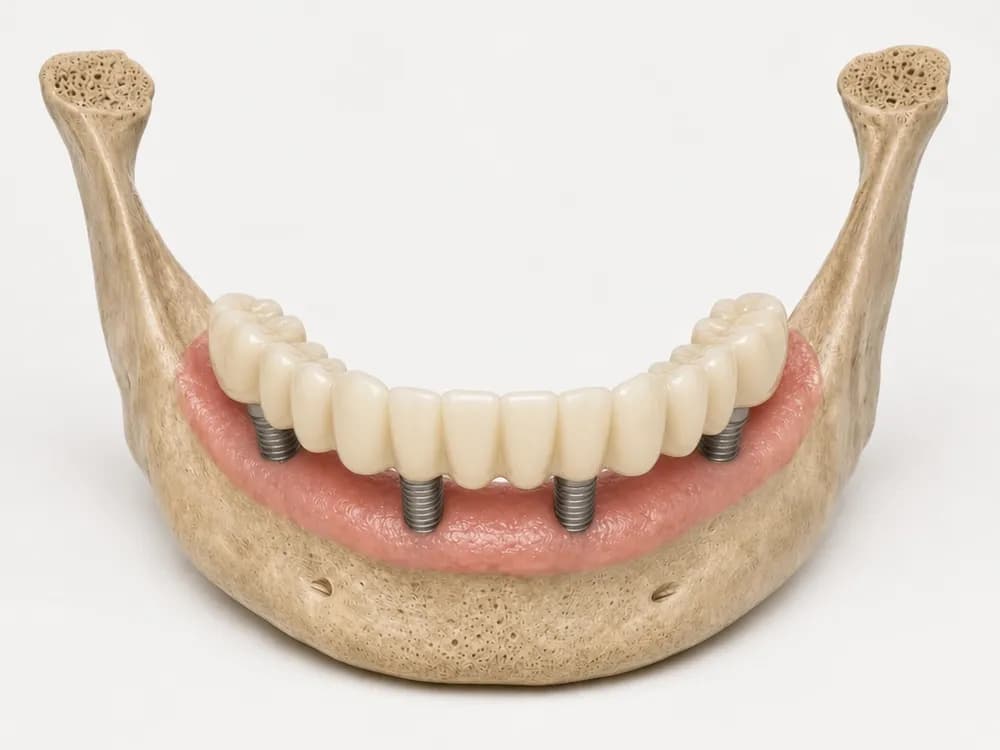
Step 3: A fixed temporary, the same day
You do not leave without teeth. A fixed temporary bridge goes on at the same appointment — it is lighter and flatter than the final one, and it is what you wear while the bone integrates.
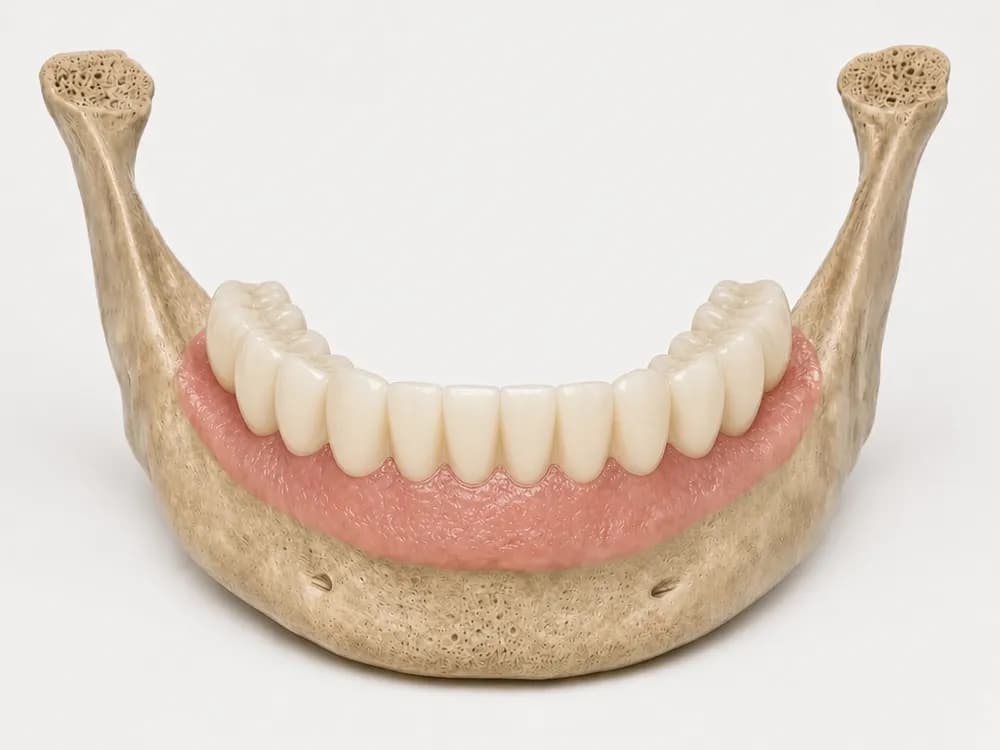
Trip 2 · days 1–7
Step 4: The permanent bridge
Months later, on the second trip: the final arch, in proper ceramic, made to a bite that has settled. This is the one you keep.
Medical renders of the stages of the procedure, on anatomical models. Not photographs of a patient, and not a before-and-after — no result shown here belongs to anyone. Your own case is planned at the UK examination.
Real cases
Ballıpınar's own patients, before and after
Photographs, not renders — published by the clinic itself. What we know about each case is written under it, and so is what we don't.
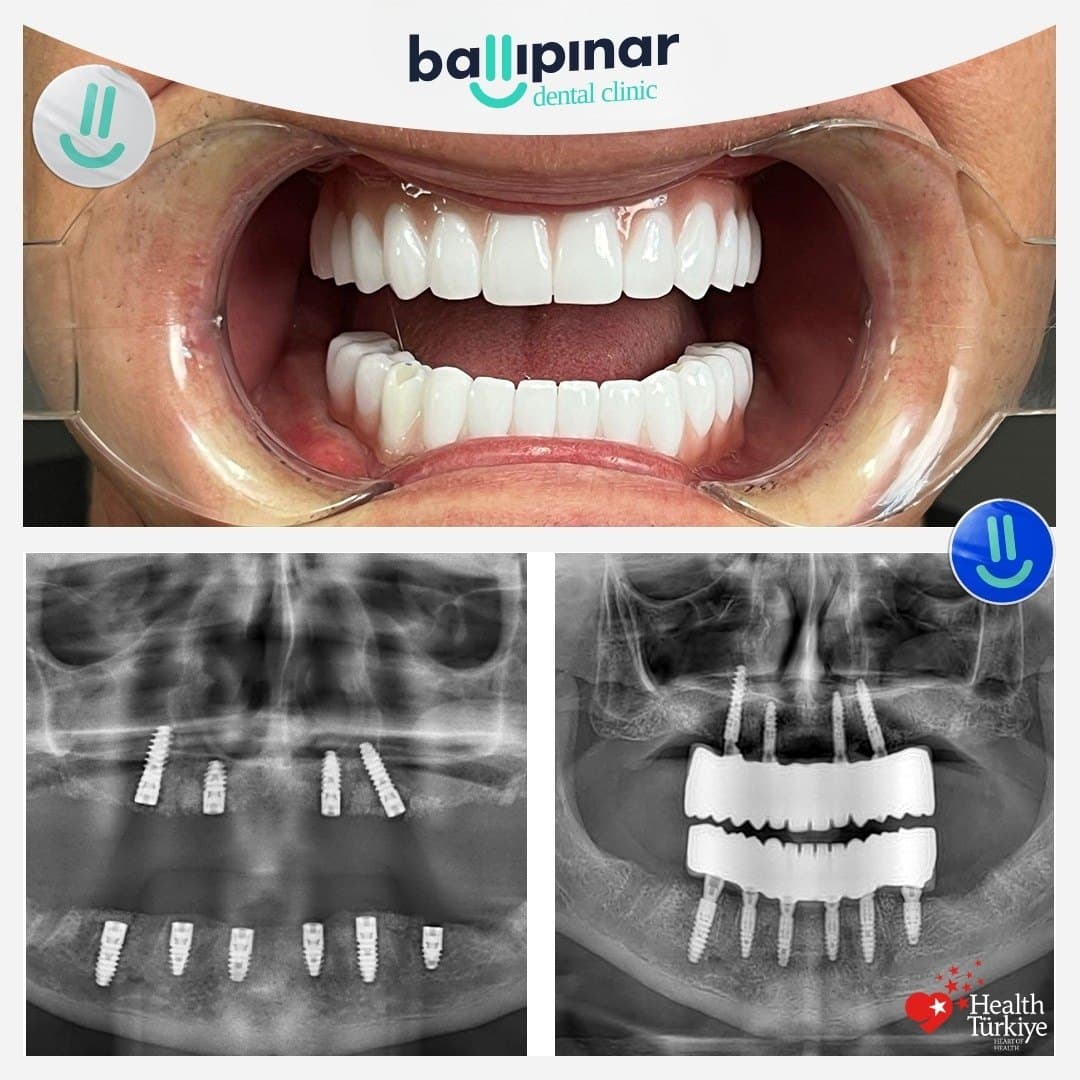
Before: Missing and failing upper teeth. 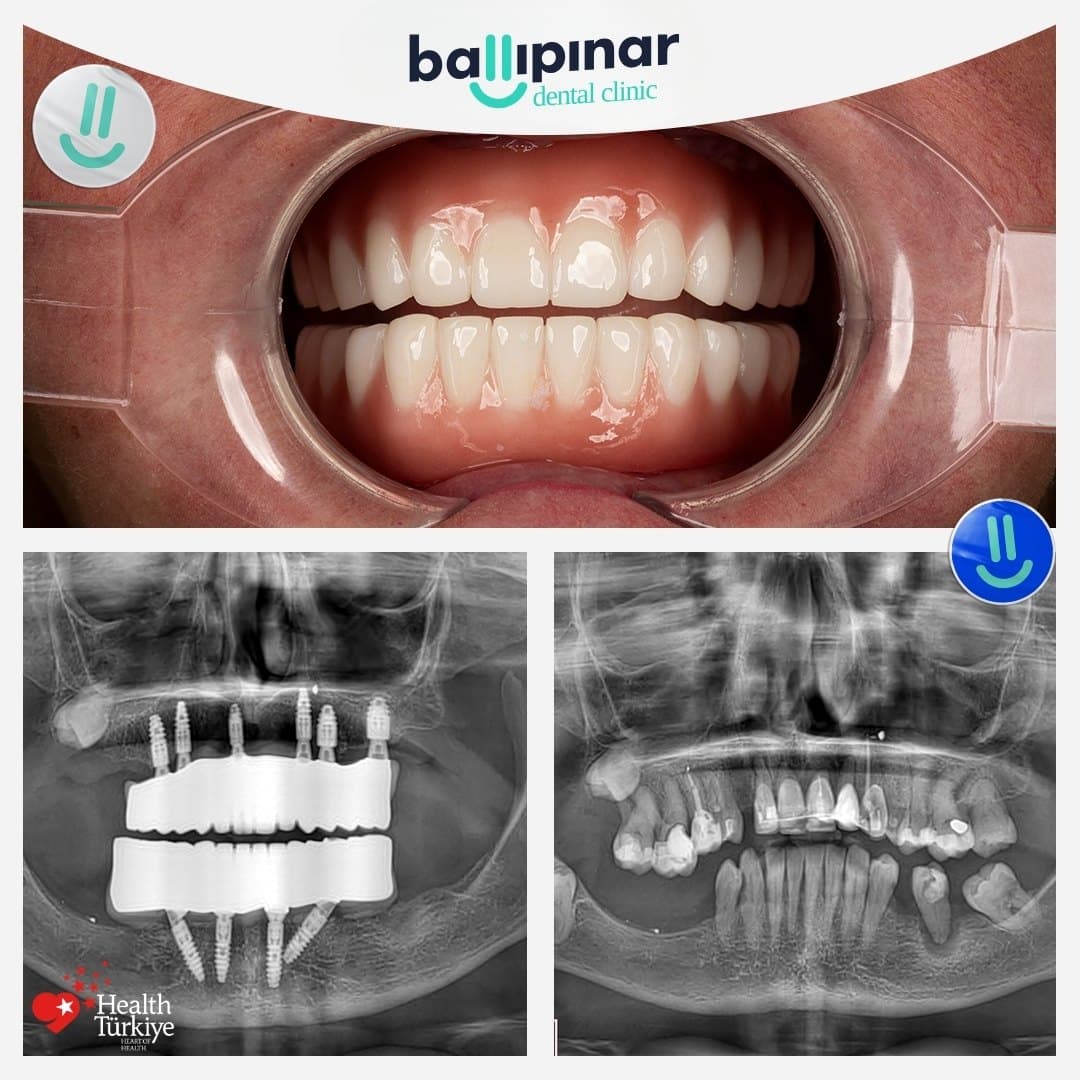
Before: Missing and failing upper teeth.
Ballıpınar's own patients, published by Ballıpınar. Mirrored on 18 August 2026 (original eight) and 18 September 2026 (nine more, by treatment) from Ballıpınar Dental Centre's own published case gallery. Nothing on this page is generated, and no other clinic's photographs appear anywhere on this site.
What we cannot tell you about them. The clinic's gallery carries no case notes, so we do not know which materials were used in each case, how long after treatment the second photograph was taken, or whether either photograph was edited. We would rather say that than imply a timescale nobody has confirmed.
2 cases, not a typical result. What is achievable depends on your own teeth, gums and bone, and is assessed at the UK examination — not from a photograph of somebody else. Some people are told a smaller job would suit them better, and some are told to have gum treatment first.
How it works
From your UK examination to Antalya
We see you in person in the UK before anything is booked. It's the step that turns a photograph-based estimate into a plan.
Send us photos and any X-rays you have
OnlineA few photos of your teeth and whatever your UK dentist has already given you. We come back with an idea of what's possible and a ballpark cost — free, and with no obligation to go further.
See us in person in the UK
In the UKWe examine you face to face at a clinic in the UK before anything is booked. It's the step that lets us plan properly rather than guess from a photograph, and it means you meet someone before you commit to flying.
Get a written plan with a fixed price
In the UKTooth by tooth: what's being done, which materials, how many trips, and what the total is. Nothing on it changes once you've agreed it, and anything not included is listed as not included.
Fly to Antalya
In AntalyaYou book the flights; we arrange the airport transfer and hotel. Your coordinator has your schedule and meets you on arrival.
Treatment at the clinic
In AntalyaCarried out by the dental team at Ballıpınar in Antalya, to the plan you signed off. Your coordinator stays with you across appointments.
Recovery, and how long all-on-4 implants last
This is the biggest recovery of any treatment on this site. Planning your flights and your fortnight around it, rather than around a holiday, is most of what makes it go smoothly.
- Days 1–7
- Significant swelling and bruising, peaking around day two or three, then easing. Liquid and very soft food. Ice, prescribed medication, sleeping propped up. No smoking — this is the single worst thing you can do to a fresh implant site.
- Weeks 2–6
- Swelling gone, soft diet continuing and gradually widening. The temporary bridge is fixed but not indestructible: no crusty bread, no nuts, nothing you have to tear. Cleaning under the bridge starts properly here and becomes a daily habit.
- Months 2–6
- You will feel completely normal well before the implants are ready for the permanent bridge. The gums shrink slightly as they settle, which is exactly why the final bridge is made at the end of this period rather than at the beginning.
- Call someone if…
- Pain increases after day three, you develop a fever, the temporary bridge loosens or a screw feels like it is moving, or numbness in the lip or chin has not lifted. None of these should wait for your next flight.
How long it lasts
A full-arch bridge is not a one-off purchase, and any clinic presenting it as one is setting you up for a disappointment. The implants are the long-term component. The bridge on top is a wearing part: acrylic teeth discolour and wear over years and are refurbished or remade, and screws are checked and retightened at reviews. What decides how long the whole thing lasts is largely cleaning — a fixed bridge has an underside that a toothbrush alone does not reach, and peri-implant infection is the realistic way these fail. Budget for hygienist appointments at home the way you would budget for the treatment, because that is the maintenance the price does not include.
What can go wrong with all-on-4 implants, and what reduces it
Every item here can happen in a UK practice too. What travelling changes is how easily it gets sorted out — which is the reason this site puts a UK examination in front of a flight.
An implant failing to integrate
Where one of four fails, the whole bridge is affected — which is the honest downside of fewer supports. Smoking, uncontrolled diabetes and untreated gum disease carry most of this risk, and being assessed properly beforehand is the mitigation.
Peri-implant infection from cleaning that never quite happened
Interdental brushes, a water flosser and a hygienist at home on a schedule. This is the realistic long-term failure mode, and it is largely preventable.
Teeth removed that could have been kept
Get a second opinion before agreeing to clear an arch, particularly if several teeth are still sound. It cannot be undone, and a clinic that has not discussed alternatives has not planned your treatment.
The bridge feeling bulky, or speech changing
Normal at first and it settles, but it should be raised at the try-in stage rather than accepted at handover. A fixed bridge sits differently from natural teeth and you are allowed to say so before it is finalised.
No one at home to service it
Leave with the implant system, the bridge material and the screw type in writing. A UK dentist can remove and refit a documented bridge; an undocumented one is a much harder conversation.
“Will a UK dentist touch it when I get home?”
It is the most asked question about dental treatment abroad, and the answer is more practical than most of the arguing suggests. UK dentists are not refusing work on principle. They are refusing to guarantee treatment they did not carry out and cannot identify — and on that, they are right. A dentist asked to adjust a crown needs to know what it is made of; asked to service an implant, they need the system and the part numbers.
So the thing that decides how this goes for you is paperwork, and it is settled before you fly rather than after. You leave with the materials named, the components identified, your radiographs and a written guarantee that says what is covered and for how long. And because we examine you in the UK before anything is booked, there is a named person here to call — not only a WhatsApp number in another time zone.
A full-arch bridge is the treatment where documentation matters most. The bridge is screw-retained, so a UK dentist may need to remove it to clean or repair underneath — and to do that they need to know the implant system, the screw type and the driver. Go home with all three in writing, plus your radiographs.
This answer applies to all-on-4 implants treated at our Antalya clinic.
When all-on-4 implants are not the answer
We would rather lose the enquiry than sell you the wrong treatment. Any of these can be the better call, and the UK examination is where that gets decided.
All-on-6
When there is bone for six implants and the bite is heavy — most often the lower arch, and for people who grind.
An implant-retained overdenture
When you want the stability of implants at lower cost. It clips onto two or four implants and comes out for cleaning — easier to maintain, and considerably less expensive.
A conventional full denture
When surgery is not advisable or the budget is not there. It moves, and most people who choose an implant option are choosing it precisely to escape that — but it remains a real treatment.
Saving the teeth you still have
Whenever it is possible. Gum treatment, root canals and individual crowns are less final than clearing an arch, and worth a second opinion first.
| Treatment | Trips | Time in Antalya | Cost |
|---|---|---|---|
| ImplantsSurgical | Two | Two trips. Roughly 3–5 days for placement, then 3–7 days for the crown after healing — usually 3–6 months apart. | See costs |
| VeneersCosmetic | One | One trip, usually 5–7 days from preparation to fitting. | See costs |
| All-on-4This pageSurgical | Two | Two trips. Around 7–10 days for surgery and the temporary bridge, then 5–7 days for the final bridge 3–6 months later. | Costs in full |
| All-on-6Surgical | Two | Two trips. Around 7–10 days for surgery, then 5–7 days for the final bridge 3–6 months later. | See costs |
| Hollywood SmileCosmetic | One | One trip, usually 6–8 days. | See costs |
| CrownsRestorative | One | One trip, usually 5–7 days. | See costs |
| WhiteningPreventive | One | One trip, 1–3 days — often combined with other treatment. | See costs |
Where people travel from
Each of these pages works out what all-on-4 implants would cost from that town — the treatment, plus the return flight from the airport we route the town through, counted once for every trip the treatment needs. The UK prices they compare against are national ranges rather than any one town's.
Common questions
Will a UK dentist look after an All-on-4 bridge fitted in Turkey?
Routine care, hygienist maintenance and most repairs, yes — provided they can identify what is in your mouth. A full-arch bridge is held on with screws, and removing it for cleaning or a repair means knowing the implant system and having the right driver. That information is a line on a piece of paper, and any clinic should give it to you without being asked. Register with a UK practice when you get home and take the paperwork to the first appointment.
What are the downsides of All-on-4?
Three real ones. First, it means removing whatever teeth are left in that arch, which is irreversible. Second, four implants means fewer points of support than six, and if one fails the whole bridge is affected. Third, it needs cleaning underneath, every day, for as long as you have it — a fixed bridge is not a set of teeth you stop thinking about. None of those make it the wrong treatment; they make it a treatment you should choose deliberately.
All-on-4 or All-on-6 — which do I need?
It depends on your bone volume and your bite, not on budget. More implants spread the load and can be the safer plan in a lower jaw with heavy chewing forces; four can be entirely adequate elsewhere. This is decided from a CBCT scan, and a clinic that names the number before it has seen the scan is selling, not planning.
How long do I have to stay in Turkey for All-on-4?
Around 7–10 days for the surgical trip and 5–7 days for the final bridge, three to six months apart. The first trip is longer than for a single implant because the swelling has to be reviewed and the temporary bridge adjusted before you are on a plane.
Is All-on-4 the same as a denture?
No. A denture rests on the gum and comes out. An All-on-4 bridge is screwed onto implants and stays in — you clean around it rather than removing it. That is also why it costs more and why the maintenance matters.
Do I get teeth the same day?
Usually a fixed temporary bridge goes on during the same visit, so you are not toothless. The permanent bridge comes on the second trip, once everything has healed and the fit can be made properly.
How painful is it?
The surgery itself is done under local anaesthetic with sedation available, so it is not painful at the time. The days afterwards are the part to plan for: swelling and bruising peaking around day two or three, a soft diet for a week or two, and prescribed pain relief. Most people describe it as manageable but genuinely uncomfortable, and it is not a trip to combine with a full holiday itinerary.
How long does an All-on-4 bridge last?
The implants are designed to be the long-term part; the bridge on them is a wearing component that may be refurbished or remade over the years, particularly if it is acrylic. What decides the outcome more than anything is cleaning under the bridge and seeing a hygienist regularly. Anyone quoting a fixed number of years for the whole thing is quoting a marketing figure.
No obligation
Find out what your treatment would actually cost
Send us a few details and we'll come back within a working day with what's involved and what it costs. We examine you in the UK before anything is booked.
We'll tell you if you're better off treated at home.