Cost
Why are dental implants so cheap in Turkey?
Where the price difference genuinely comes from, where it doesn't, and how to tell which kind of cheap you're being offered.
"If it's half the price, what are they cutting?" is the right question to ask, and it deserves a real answer rather than reassurance.
Most of the difference is genuine and structural. Some of it, at some clinics, is not. Here is how to tell them apart.
Where the difference genuinely comes from
Wages. A dental nurse, a receptionist, a technician and a dentist all cost substantially less to employ in Türkiye than in the UK. Staff are the largest line in most dental practices' costs, so this alone moves the number a long way.
Premises. Rent and rates for a clinical space in Antalya bear no relation to rent for the equivalent in central London, or Manchester, or a market town in Surrey.
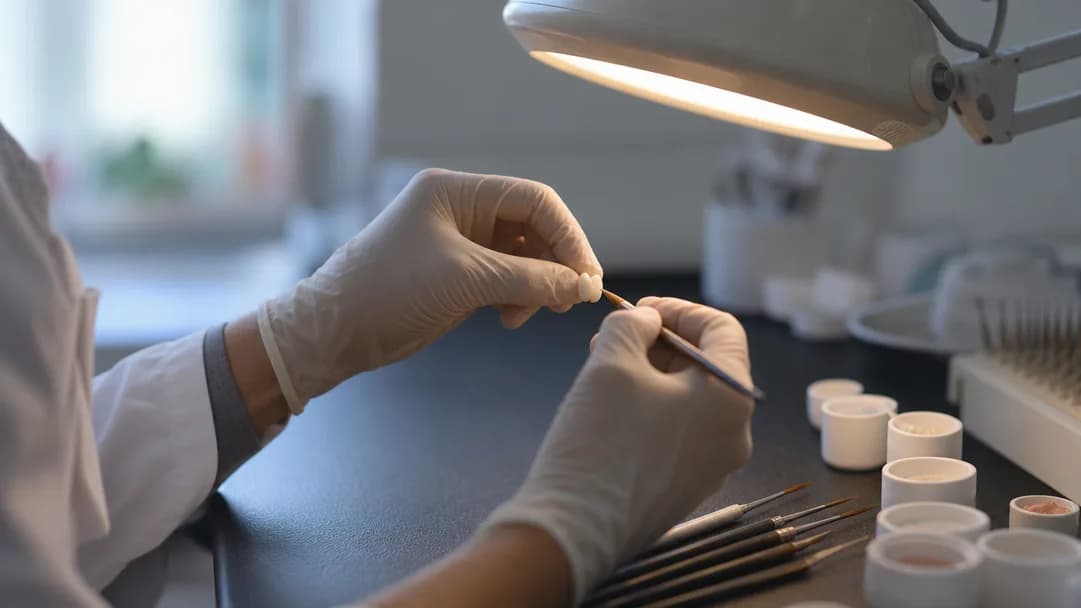
Laboratory work. Crowns, bridges and veneers are made by technicians in a lab. Turkish lab fees are a fraction of UK ones, and many larger Turkish clinics have the lab on site, which removes a markup and shortens the turnaround — which is also why a single-trip veneer case is possible there and awkward here.
The exchange rate. Prices are set in a weaker currency and paid in a stronger one.
Volume. A clinic treating international patients full-time does more implant cases in a month than a general practice does in a year. That is efficiency, and it shows up in the price.
Add those together and a large gap is entirely explicable without anything being cut.
Where it does not come from
The implant itself. This is the part people assume is the saving, and it usually is not. Straumann, Nobel Biocare, Astra and the other established systems are sold on a global market at broadly similar prices. A Turkish clinic buying a branded implant pays roughly what a British one pays.
Which means: if a quote is far below what other Turkish clinics charge, the difference has to come from somewhere the market does not discount. Nine times out of ten that is an unbranded implant system.
The zirconia and porcelain. Same story. Material costs are international.
Sterilisation and clinical standards. These are regulated, and a licensed clinic is not saving money here. If one is, that is not a cheap clinic — it is a dangerous one, and the answer is not to negotiate.
The test that actually works
Do not compare a Turkish quote against a UK quote to decide whether it is suspicious. Compare it against other Turkish quotes.
A clinic priced in line with its peers is running the normal cost structure described above. One priced dramatically below them has made a choice, and you are entitled to know what it was. Ask the two questions that expose it:
- What implant system, and can I see the certificate? An unbranded implant is cheaper to buy and much harder to service later — if a component fails in five years, a dentist anywhere can order a part for a known system and cannot for an unknown one.
- Is the lab in-house or outsourced, and what is the crown material? "Zirconia" covers a range. Monolithic zirconia and a cheap layered alternative are not the same product.
A clinic that answers both plainly is running a normal business. One that deflects is telling you where the saving came from.
Why this matters more than the headline figure
The stories that put people off dental tourism are almost never about a clinic being cheap. They are about a clinic being opaque — a plan that changed after arrival, a veneer that turned out to be a crown, a guarantee nobody would put in writing.
Price transparency and clinical transparency tend to travel together. A clinic that will name its implant system, itemise its plan tooth by tooth and hand you the guarantee document before you pay is usually the same clinic that has nothing awkward in its pricing either.
Where a UK private fee actually goes
It helps to see what you are comparing against, because the British figure is not inflated — it is the cost of running a British practice.
A UK private fee carries premises on a high street with UK commercial rent and rates, clinical and nursing salaries at UK levels, GDC registration and professional indemnity, a UK dental laboratory bill, decontamination and CQC compliance, materials, and the practice's overheads and margin. None of that is waste. It is also why two practices five miles apart quote differently for the same crown: their rent differs, their staffing differs, their lab differs.
Change the country and most of those lines fall while one — the components — stays exactly where it was. That is the whole explanation, and it is enough to account for the gap without anything sinister being involved.
What volume does to the numbers
There is a second factor that gets less attention than the exchange rate and probably deserves more.
A high-street practice in Britain runs two or three surgeries and treats a local population across the full range of dentistry, most of it small. A clinic built around international patients runs more chairs, works longer days, and does a much higher proportion of large cases — full arches, multi-unit restorations, smile designs. Fixed costs are spread across far more treatment, and the laboratory relationship is different when you are sending work every day rather than every week.
This cuts both ways, and it is worth being honest about. Volume produces genuine efficiency and it also produces the pressure that leads a bad clinic to over-treat. The same operating model that makes a well-run high-volume clinic good value makes a badly-run one dangerous.
The one test that actually works
Everything above is context. This is the thing to do.
Ask the clinic to name the implant system, and ask to see the certificate.
A named system — Straumann, Nobel Biocare, MegaGen, Osstem, and others with a manufacturer and a documented record — costs roughly the same to buy wherever you are. A clinic using one and charging far below the local market is either absorbing the difference or making it up elsewhere. A clinic that will not name the system is not answering, and the non-answer is the answer.
The same test applies to ceramics. "Premium porcelain" is not a material. E-max, monolithic zirconia, layered zirconia and metal-ceramic are, and they sit at different prices for good reasons.
Why this matters more than the headline number
If a saving comes from wages and rent, it costs you nothing. If it comes from an unbranded implant, it costs you something specific and it costs you later.
An implant is a manufactured component with a part number. In ten or fifteen years, if a crown needs remaking or an abutment loosens, a dentist has to identify the system before they can order the matching part. With a named system that is a catalogue lookup. With an unbranded implant it can be genuinely impossible, and the fix becomes removing something that was working.
That is the real reason to care where the discount comes from — not because a cheap implant fails sooner, but because a nameless one strands you.
What we do about it
Our prices are on the comparison page next to typical UK private ranges, and the calculator puts flights and hotel into the total so you can see the real difference rather than a flattering one. It will also tell you when travelling is not worth it — for a single implant, once you have paid for two flights, it often is not.
More on how implant treatment actually works is in the implants guide, and the safety checklist has the full list of questions worth asking whoever you are talking to.